When the Corner Shop Became a Neighbourhood Landmark
A corner shop neighbourhood landmark helps residents give clearer directions, find meeting points and see how an ordinary storefront becomes part of local identity.
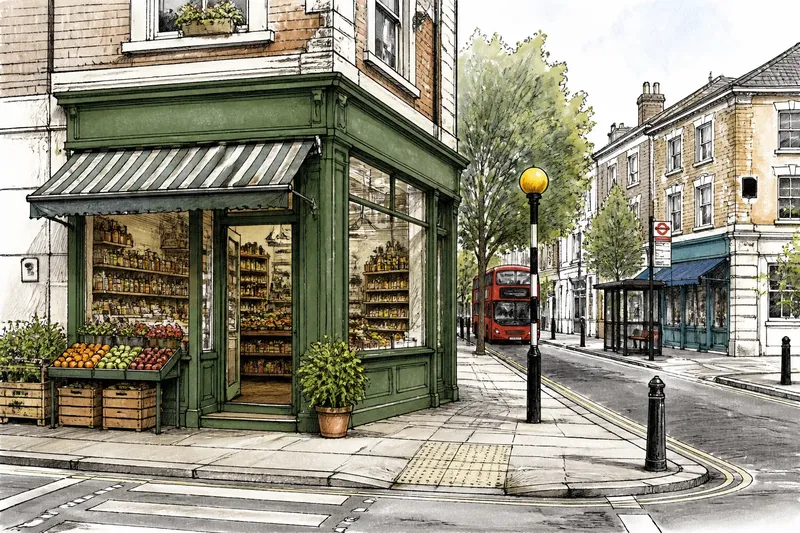
The common mistake is to assume a neighbourhood landmark must be grand, old or officially protected. That overlooks the corner shop people use to explain where to turn, where to meet and how a place fits together. A corner shop neighbourhood landmark earns its status through repetition, not ceremony.
How does a shop become a landmark?
A familiar storefront becomes a landmark when people use it as more than a place to buy something. Its position makes it easy to locate; its appearance gives it a recognisable outline; repeated visits attach memories to it. These qualities accumulate without anyone deciding that the shop is now important.
At first, the shop may be a practical stop on the way home. Later, a resident might describe a route as “past the grocer, then left”, even if the grocer is not the destination. The shop has become part of the neighbourhood’s shared vocabulary.
This does not require a picturesque façade or a celebrated owner. A plain awning, a bright window or a sign visible from the crossing can do the work. In a city full of similar blocks, one distinctive doorway can be easier to remember than a street name.
Why do landmarks help people find their way?
Addresses describe a location precisely, but they do not always help someone picture a route. Local directions often rely on a sequence of visible cues: the bus shelter, the bakery, the narrow lane. A shop at a junction is especially useful because it sits where a person must make a decision.
Its role is partly spatial. A storefront can mark the edge between two stretches of street, the point where a residential road meets a busier avenue, or the entrance to a small cluster of side streets. People use it to divide a route into manageable pieces.
It is also social. “Meet outside the chemist” tells someone not only where to stand, but which part of the neighbourhood the speaker has in mind. A landmark gives a shared reference to people who may know the area differently: a new tenant, a delivery rider, a parent collecting a child.
Say a new resident is trying to reach a community hall from the bus stop. A neighbour might say, “Walk towards the corner shop, then take the narrow street beside it.” The resident can match that instruction to the visible shop and street, then recognise the turn without having to interpret a string of unfamiliar street names.
What makes a storefront memorable?
Landmark status depends less on architectural distinction than on legibility. A shop is useful as a reference point when people can pick it out quickly and connect it to a stable place. Several ordinary features may help:
- A clear position: a corner, junction or route entrance is easier to describe than a shop hidden midway along an unbroken frontage.
- A recognisable face: a contrasting sign, deep doorway, striped awning or distinctive window display can separate it from neighbouring units.
- Visibility along the route: a storefront seen before a turn helps people anticipate where they are going.
- Repeated public use: regular errands, brief conversations and informal meeting points build familiarity through ordinary contact.
- A relationship to nearby places: the shop may help residents explain how the bus stop, housing, school or local hall connect.
These are clues, not a formula. A bright sign can make a business noticeable without making it meaningful. Familiarity grows when people encounter the place as part of everyday life, not merely when it stands out in a photograph.
What changes when a landmark shop changes?
When a shop closes, moves or changes its frontage, the loss can be practical as well as sentimental. A local direction may no longer make sense to someone unfamiliar with the area. A meeting instruction becomes vague; a turn once described by a recognisable sign now needs another cue.
The neighbourhood does not lose its ability to orient itself, but its shared map has to adjust. Residents may begin using a new shop, a bus stop or a public building as the reference point. That change is often gradual: people keep using the old name in conversation after the storefront has disappeared, while newcomers learn the replacement.
Change can also make visible who a neighbourhood’s familiar landmarks serve. If a long-standing shop is replaced by a use that attracts different visitors, some residents may still recognise the building but stop treating it as their meeting point. The physical address stays put; the social reference shifts.
What do people ask about a corner shop neighbourhood landmark?
Does a landmark have to be historic?
No. A place can become a landmark through everyday recognition, even if its building is recent and its design is unremarkable. History may deepen its meaning, but repeated use and a clear position can be enough to make it a local reference.
Can a small shop shape neighbourhood identity?
It can contribute to identity by giving people a shared point of reference and a familiar setting for routine encounters. It does not represent every resident or define the whole neighbourhood; its significance depends on who uses it and what memories gather around it.
What happens if the shop closes?
People may keep using the shop’s name as a direction for a while, then adopt a newer landmark as habits change. The replacement may be another storefront, a transit stop or a public building, depending on what remains visible and useful along the route.
Can a new business become a landmark quickly?
It can become noticeable quickly, but shared recognition takes repeated encounters. A distinctive sign may help people identify it, while regular use and conversation give it a role in the neighbourhood’s mental map.
Why does this small landmark matter?
A corner shop landmark is a modest piece of local infrastructure. It helps people describe routes without consulting a map, gives newcomers a visible point of reference and carries fragments of neighbourhood memory. Its usefulness is not limited to customers: someone can rely on the storefront as a cue without entering it.
That makes the corner shop neighbourhood landmark worth noticing before it is treated as nostalgia. Watch how people give directions, where they arrange to meet and which storefront names persist in conversation. Those habits reveal which places have become part of the neighbourhood’s working map.
When a familiar shop changes, keep an eye on what takes its place in local directions. The next landmark may be less obvious, but the neighbourhood will show you where its new reference point has settled.