How to Read an Arcade on a Rainy Afternoon
Learn how to read an arcade on a rainy afternoon by tracing thresholds, shifting light and pedestrian routes without mistaking shelter for empty space.
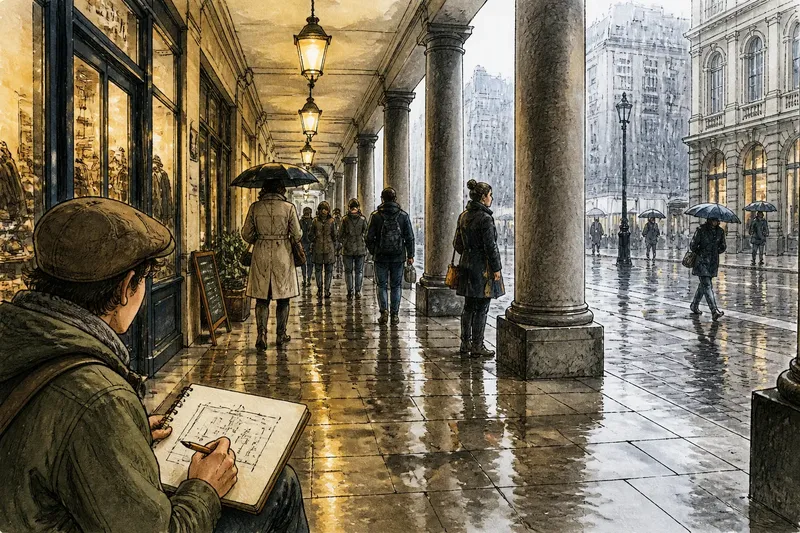
The common mistake when reading an arcade is to treat its roof as a simple shelter and its pavement as a corridor. That misses the negotiation happening at every edge: people slow, turn, wait, or step into rain, and the covered route can quietly shape who feels able to move through. To read an arcade on a rainy afternoon, start at its entrance and follow those changes rather than trying to take in the whole street at once.
Where should you begin?
Choose a public place where the arcade or covered street is easy to see from a dry, unobstructive position. A passage beside shops, a colonnade along a civic building, or a covered market street will all work. Avoid standing in a doorway or narrowing the route; you are there to observe shared space, not to become its least useful bollard.
Bring a small notebook and pencil, or use a phone to make brief written notes. Do not photograph people without permission. You need not identify anyone: record where movement changes, not who is moving. If the weather is severe, or the surface is slippery, choose a safer vantage point or leave the exercise for another day.
First, mark a simple plan. Draw the arcade as a long strip, then add the open street, shop entrances, columns, walls, steps, benches, drains and any obvious gaps in the roof. Keep it rough. The plan is a memory aid, not a submission to the municipal cartography office.
Stay in one position for a short while before following the route. Note what is already happening: where people enter, where they leave, and whether anyone pauses. This gives you a baseline before your attention starts directing your feet.
What does the threshold change?
Now follow one boundary between cover and open air. A threshold may be a roof edge, a line of columns, a change in paving, or a doorway set back from the main path. It is often more complicated than a sharp line. A broad overhang can keep the pavement dry beyond the columns; wind can push rain beneath it; a shop awning can extend the sheltered zone further along.
Watch how people respond as they approach that boundary. Do they continue straight, angle inward, hesitate, or cross into the rain to pass someone? Notice whether a column creates a pinch point or whether a recess lets a person stop without blocking others. Record the physical cue alongside the movement: “paving changes at the edge; two people move towards the wall” is more useful than “the entrance feels awkward”.
Then look for thresholds that are not about weather. A raised sill, a step, a heavy door, a display, or a narrow gap between a column and a shopfront can divide a route into public passage and private invitation. Do not assume that a door left open is an invitation to enter. The point is to notice how access is signalled, not to test it.
On your plan, use a short line for each place where movement appears to change. Add a note only when the reason is visible or reasonably clear. If you are unsure, write “possible obstacle” rather than turning a guess into a finding.
How does the light mark the route?
Look up, then look down. The roof may be solid, glazed, perforated, or interrupted by gaps between buildings. Each arrangement changes the contrast between the sheltered path and the open street. On a rainy afternoon, reflected light from wet paving can brighten a covered bay, while a deep roof can leave the entrance dim even when the street outside looks bright.
Notice where the light falls, not merely whether the arcade is bright or dark. Does a glazed panel make one section easier to read? Do columns cast alternating bands across the pavement? Does a dark stretch lead towards an entrance that is difficult to distinguish? Note whether people adjust their route around shadows, glare, puddles or reflections.
Light also makes the rain visible. Water may run from a roof edge, gather in a dip, or scatter from passing traffic. A patch of wet flooring can become a practical boundary, even when no wall or sign marks it. Describe what you can see, without claiming to know the drainage system behind it.
Sketch the brighter and darker areas with loose shading. Add an arrow for the direction of the rain or wind if it is apparent. If the weather changes while you are there, note the change rather than treating your first impression as permanent. An arcade is not a still photograph, however much the columns might suggest otherwise.
What should you watch as people move?
Choose one short section of the arcade and follow the flow in both directions. Watch for passing, stopping, queueing, turning into shops, and stepping around objects. Note whether people tend to keep to one side, spread across the width, or form temporary lanes around a fixed obstruction such as a display board.
Pay attention to the moments when sheltered and open routes meet. Someone may leave the cover to avoid a crowd; another may move inward to make room for a person carrying bags. A cyclist may pass through, if cycling is permitted, while a delivery trolley pauses near a shop. Write down only the movement and the setting. Avoid assigning motives that a brief observation cannot support.
Say you are standing beneath a covered market street where rain falls beyond the last row of columns. In an invented situation, you notice that people approaching from the open pavement angle towards a dry strip beside the wall, then bunch briefly near a narrow shop entrance. You could mark the roof edge, entrance and resulting change of direction on your plan; the observable result is a clearer account of where shelter helps movement and where the entrance interrupts it. That is a useful observation, not a verdict on the whole arcade.
Compare the movement under cover with the movement just beyond it. Is the open pavement used as a route, a waiting area, or both? Does the arcade connect two destinations, or do people mostly enter and leave at the same end? A few clear notes about direction and pauses will tell you more than an elaborate tally without context.
How can you keep the observation fair?
Rain changes the scene, but it does not explain everything. A quiet stretch may reflect the time of day, a closed shop, construction, or the location of a bus stop nearby. Record visible conditions beside your notes: whether doors are open, whether a shop is operating, and whether any temporary barrier is present.
Keep the exercise proportionate. You are describing a place during a particular visit, not establishing how every person uses it. Do not follow individuals, record identifying details, or infer disability, income, age, purpose, or background from appearance. If an access issue seems relevant, describe the feature directly: “single step at the side entrance”, for instance, rather than guessing who can or cannot use it.
Use a small set of symbols consistently: an arrow for direction, a dot for a pause, a wavy line for water, and shading for low light. Add plain words where a symbol could mean two things. The resulting map should be legible to someone who was not standing beside you in the drizzle.
What can you ask after you leave the arcade?
What counts as a threshold in a covered street?
A threshold is any edge or change that affects how people pass between spaces, including a roof line, step, column, doorway or shift in paving. Some boundaries are physical; others become apparent through the way movement changes.
Why observe an arcade in the rain?
Rain makes the sheltered and exposed parts easier to distinguish, while wet surfaces reveal where water travels and where people avoid it. The weather also makes clear that cover is not necessarily continuous or equally useful along the whole route.
Should I count every person who passes?
Not for this exercise. A brief count can lose the detail of turning, waiting and sharing a narrow passage, and it can imply a precision the observation does not have. Record a few recurring movements and the features associated with them.
What should I do with the notes afterwards?
Read the plan beside your written observations and separate direct description from interpretation. If the aim is to inform a local discussion, share the specific locations and visible conditions, while making clear that the notes describe one visit rather than a settled account of the place.
How do you finish the walk?
Before leaving, return to the entrance where you began and look back along the covered route. Check whether your sketch includes both ends of the sheltered zone, the points where people cross its edge, and any places where water or light altered the path. Add a note if an important detail only became apparent while walking.
Then write a short description in ordinary language: where cover begins and ends, what changes at the thresholds, and how movement responds. Keep observation and interpretation distinct. “People turn towards the wall where the roof edge lets in rain” describes a visible pattern; “the arcade is badly designed” is a judgement that would need more than one rainy afternoon.
A careful reading of an arcade on a rainy afternoon leaves you with something modest but useful: a plan of the route as people encounter it, not merely as it appears in an architectural drawing. Keep the sketch beside the date and weather conditions, so anyone returning to the place can see what was observed and what remains an open question.