Square, Park or Pocket Green: What Kind of Pause Do You Want?
Compare a square, park and pocket green to choose a public space with the right setting for a quiet break, short walk or easy meet-up.
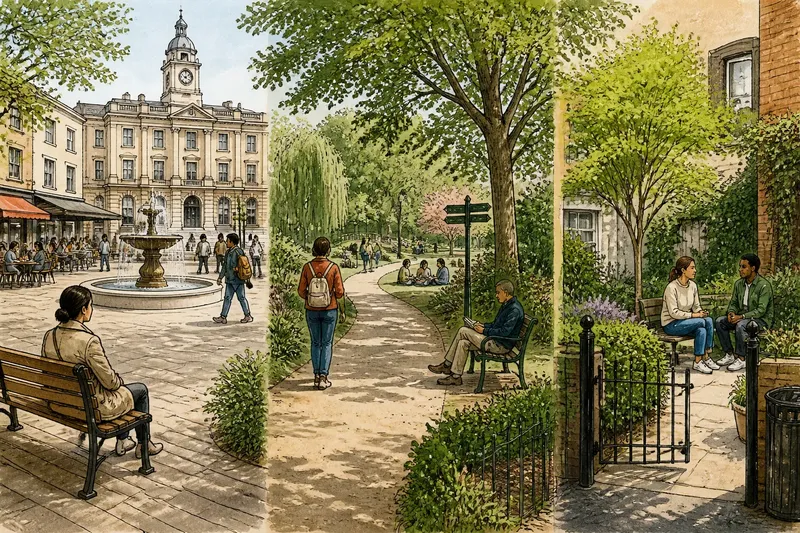
The common mistake is choosing a public space by its name, then finding that the bench faces a busy route or the lawn is nowhere near the entrance. To choose between a square, park or pocket green, match the place to what you want to do: pause, walk or meet.
What does a square make easy?
A square is framed by surrounding buildings and streets. Shopfronts, civic buildings, café tables or low walls give its open middle a clear address, making it relatively easy to see where the space begins and where people are going.
That arrangement suits a brief pause with a view of ordinary activity, or a meeting at a recognisable landmark: by the fountain, under the clock, beside the broad steps. The centre may be left open for passing through or informal events, while the edges offer places to stop.
A large paved centre can feel less restful than its map suggests. Shade, wind and noise bouncing off façades matter more than the word “square” on a sign. If you plan to sit, look for an edge seat that is out of the walking line and does not obstruct a doorway.
When is a park the better pause?
A park can separate different uses. Paths carry people through, while lawns invite a longer stop; trees, planting and changes in ground level can create quieter pockets. Its edges are less immediate than a square’s, so the experience varies from one part to another.
That variety suits an undecided visit: you can walk a circuit, sit beneath a tree or find somewhere to talk away from the main route. The trade-off is that a larger park may take time to cross, and a quick break can turn into a search for the right corner.
Notice where paths meet. A bench beside a junction offers movement to watch; one beyond it may feel calmer. A broad lawn can suit a group, but it may be less useful than a firm path if someone needs a mobility aid or is bringing a wheeled bag. For a short walk, choose a route with a visible turning point and an obvious way back.
Why choose a pocket green?
A pocket green is a small planted public space set into the city’s ordinary fabric: perhaps a planted courtyard, a narrow green beside a block or a modest garden set back from a street. Its scale makes it easy to take in at a glance.
That intimacy suits a short pause or a meeting between a few people. A hedge, fence, wall or building edge can soften nearby street activity and make a seat feel sheltered. The same boundary can limit views or make a public place seem private, so look for a clear entrance and signs that visitors are welcome.
A pocket green is rarely the best setting for a long walk. It may offer only a path across or a short route around planting. Its value is putting greenery close to everyday destinations, not imitating a park on a smaller plot. If there is only one bench, check whether it serves more than one person or leaves room for others to sit nearby.
How do you choose a public space for your pause?
Which place suits a quiet break?
Choose a seat with some shelter and distance from the main path. A pocket green may feel contained; a park offers more choice, while a square can work if its edges provide shade or a quieter seat.
Which place suits a short walk?
A park is usually the easiest fit because it may offer a route with a turn or loop. A square works for a brief circuit around its perimeter, while a pocket green is better treated as a small detour.
Where should a group meet?
Choose a recognisable landmark and enough room to wait without blocking movement. A square often makes the meeting point easy to describe; a park suits a group that wants space to spread out after everyone arrives.
What should you notice before settling?
Check the entrance, path surface, seating, shade and the flow of people. A comfortable-looking spot may be less useful beside a service entrance or where a group would stand in the way of passers-by.
What do the edges tell you?
Edges shape whether a place feels open, protected or exposed. In a square, active shopfronts can make the boundary feel lively; a blank façade may leave the paving feeling empty. In a park, tree lines and paths can separate uses without closing them off. In a pocket green, a hedge may provide shelter but make the entrance harder to see.
Before settling, check whether people naturally use the spot as a route, whether a doorway needs to stay clear and whether planting blocks a useful view. Accessibility belongs in this first look: a step-free entrance, firm path and seat near the entrance can make a park or small green usable for more people. Level paving is not enough if café furniture narrows the route through a square.
How do shade, sound and seating change the choice?
Shade changes with the sun. Trees may shelter a park bench, while an arcade or building shadow may offer relief in a square. A pocket green may depend on one tree or sheltered wall, so the seat that looks inviting at one time can be exposed later.
Sound varies too. Hard façades can carry voices and traffic across a square. Planting may soften the impression of noise in a park without removing its source, and a small green can remain close to a road or loading area. A quieter-looking setting is not necessarily a quiet one.
Seating hints at how a place is used. A bench facing a path suits watching and waiting; seats turned towards one another favour conversation. A long ledge can accommodate an informal group, but may not suit someone who needs a backrest or armrests. Check the seat itself rather than relying on the greenery around it.
Can one place serve different moods?
Sometimes. Imagine you are meeting a friend at a square whose open centre is exposed, but whose perimeter has a clear walking circuit and a shaded bench away from the main path. You could arrive at the fountain, walk one circuit while you talk, then sit at the bench. The square would serve both purposes; if its edges had no suitable seat, it would still work as a meeting point but not as comfortably for lingering.
A park can shift from walking to resting by moving from a path junction to a sheltered seat. A pocket green can suit a brief conversation and a moment alone, but its compact footprint leaves fewer alternatives if its only seat is occupied.
When comparing nearby places, name the activity first: wait, wander, sit, meet or watch. Then check the detail that supports it—a clear landmark, a continuous path, a sheltered seat or an entrance that is easy to find. For a quiet break, judge the seat and its immediate surroundings; for a short walk, judge the route; for a meet-up, judge the arrival point. The best choice is the one that makes your intended pause straightforward.